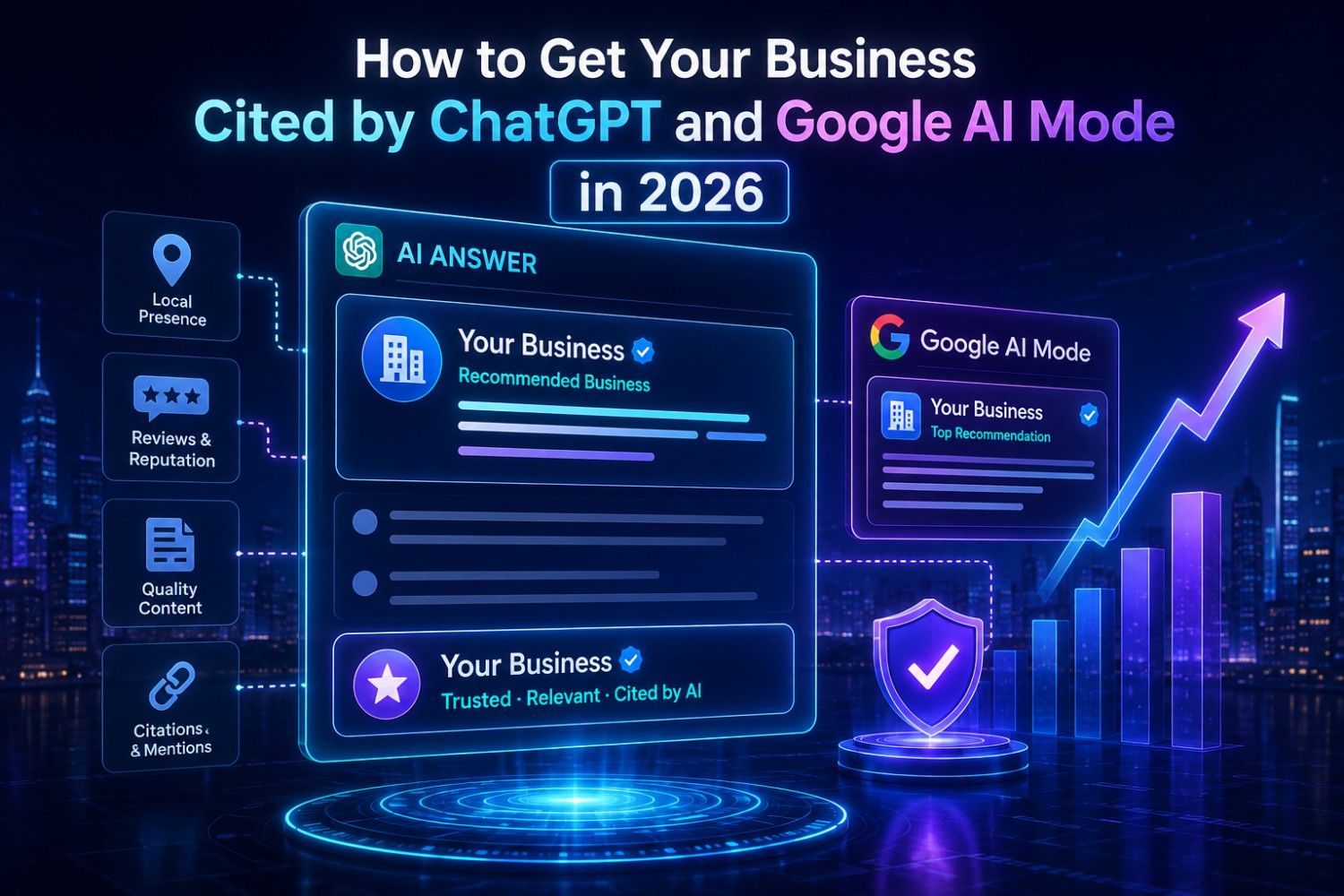
If you’ve been monitoring your website’s performance recently, you might have felt a slight chill in the air. In our previous discussion about Google AI Mode and the 2026 traffic landscape, we pulled back the curtain on why traditional organic visits are shifting. The “default” search experience is no longer a list of ten blue links; it is a synthesized, conversational response generated by an AI that has already read your website, and your competitors’ websites, so the user doesn’t have to.
This leaves business owners with a pressing, natural follow-up question: If the AI is the one answering the user, how do I make sure it’s MY business being cited as the expert?
In 2026, the goal of SEO has expanded. We are no longer just ranking for humans; we are “teaching” the AI models. Welcome to the era of Generative Engine Optimization (GEO). Here is your roadmap to becoming the cited authority in an AI-first world.
Key Takeaways
- The Citation is the New Click: In a world of zero-click searches, being the footnoted source in an AI summary is the primary way to drive high-intent traffic.
- Information Gain Matters: AI models ignore repetitive content. To be cited, you must provide unique data, personal experience, or a new perspective.
- Structure for LLMs: Large Language Models (LLMs) prefer clear, semantic hierarchies and direct “Answer Engine” formatting.
- Digital PR is Essential: AI models trust what other authoritative sites say about you more than what you say about yourself.
1. Understanding GEO: The Evolution of AI Search Optimization
For decades, SEO was about keywords. In 2026, AI search optimization is about “Entities” and “Relationships.” When a user asks Google AI Mode or ChatGPT a question, the model isn’t just looking for words; it’s looking for a trusted entity that solves the user’s problem.
This process is known as GEO (Generative Engine Optimization). To win here, your content must be mathematically “probable” as the best answer. This starts with a deep content gap analysis. You need to identify what the AI currently “thinks” is the answer and then provide the missing piece, the expert nuance, that the AI hasn’t found elsewhere. If you are just repeating what is already on Wikipedia, the AI has no reason to cite you. It will simply summarize the facts and move on.
2. How to Get Cited by ChatGPT: The Authority Loop
ChatGPT and other LLMs are trained on massive datasets, but they also browse the live web to provide real-time recommendations. To get cited by ChatGPT, your brand needs to exist in a “Trust Loop.”
- Step A: Publish original research or deep-dive case studies on your site. For example, we documented exactly how white-label SEO helped a small agency scale to 7 figures. This is original data that an AI can point to as a “source.”
- Step B: Secure mentions on third-party news sites and industry journals. This is where Digital PR services become your most powerful SEO tool. When ChatGPT sees your name mentioned in an Associated Press article and on your own blog, it connects the dots: This brand is an authority.
3. Mastering “Answer Engine” Formatting (AEO)
If your content is a wall of text, the AI might read it, but it likely won’t cite it. AI models prefer “nuggets” of information. This is the core of Answer Engine Optimization (AEO).
To increase your Google AI Mode visibility, structure your pages with the following:
- The TL;DR Direct Answer: Start your articles with a 2-3 sentence summary that directly answers the primary query.
- Semantic Bullet Points: Use lists to break down complex processes.
- Factual Density: Use specific names, dates, prices, and statistics. AI models are “fact-hungry.”
- Schema Markup: Use technical backend code to tell the AI, “This is a product,” “This is a FAQ,” or “This is a Review.”
By making your content easy for the AI to parse, you become the “path of least resistance” for the algorithm’s summary.
4. GEO for Small Business: Winning the Local AI Battle
If you are a local business owner in a city like Chicago or Austin, the stakes are even higher. When a user asks, “Who is the most reliable plumber near me?” Google AI Mode doesn’t just show a map; it writes a paragraph explaining why they should choose a specific business.
For GEO for small business, your reputation is your SEO. Google looks at:
- Review Sentiment: Not just the star rating, but the words people use in reviews.
- Profile Completeness: Ensuring your Google Business Profile is verified and fully visible.
- Local Context: Does your website mention local landmarks, neighborhoods, and community involvement?
AI models are designed to minimize risk for the user. If your digital footprint proves you are a “safe bet,” you will be the one the AI recommends.
5. Why “Information Gain” is the Key to 2026 Rankings
One of the biggest mistakes we see in 2026 is the over-reliance on AI-generated content that lacks soul. While we use AI tools for SEO to speed up our workflow, the final product must offer “Information Gain.”
Google’s recent updates have made it clear: if your article is just a rehash of the top 3 results, it will be buried. You must create content that passes AI detection, not because you’re hiding the use of AI, but because you’ve added enough human insight, case studies, and unique imagery that the content is objectively more valuable than a machine-only output.
This human touch is what improves your engagement metrics, signaling to Google that users actually like what you’re saying.
6. The Technical Shift: From Keywords to Clusters
Gone are the days of building a single page for a single keyword. In 2026, you must build an SEO strategy without chasing keywords. Instead, you should build “Topic Clusters.”
For example, if you want to be cited as an expert in “sustainable fashion,” you shouldn’t just have one page on the topic. You need a cluster of interconnected pages covering:
- Sustainable materials (Expertise)
- Ethical manufacturing (Experience)
- Price comparisons (Authoritativeness)
- Customer testimonials (Trust)
When Google AI Mode sees this web of interconnected, high-quality content, it views your entire domain as a “Topical Authority.” This is the most sustainable way to keep your website traffic healthy as the search world continues to reshape itself.
The New Bottom Line
In 2026, visibility isn’t about being seen; it’s about being mentioned. When ChatGPT or Google AI Mode cites your business, they are giving you the ultimate seal of approval. It’s a transition from being a “search result” to being a “trusted recommendation.”
At SWS Marketing Agency, we’ve spent years deconstructing these AI models to understand exactly what triggers a citation. We don’t just chase traffic; we chase authority. Whether you are looking for comprehensive SEO services or a partner to help you navigate the Answer Engine frontier, we are here to ensure your business doesn’t just survive the AI shift, it leads it.
Is your business ready for the AI citation era?
Book a strategy call with SWS Marketing Agency today and let’s put your brand on the map.
FAQs
1. How does GEO differ from traditional SEO?
Traditional SEO focuses on ranking in the “Blue Links” through keywords and backlinks. GEO (Generative Engine Optimization) focuses on getting your content included in AI-generated summaries by emphasizing authority, structured data, and “Information Gain.”
2. Can I pay to be cited by Google AI Mode?
No. Citations in AI Overviews are organic and based on the AI’s assessment of your content’s relevance and trustworthiness. However, running PPC services can help maintain visibility in the sponsored sections above the AI summary.
3. Why is my traffic dropping even though I’m still ranking #1?
This is likely due to the “Zero-Click” trend. If Google AI Mode is answering the user’s question directly on the search page, they may not feel the need to click your link. The solution is to create “click-worthy” deep dives that offer more than just a quick answer.
4. Does ChatGPT use my blog posts to answer questions?
Yes, if your site is indexed and has high authority, ChatGPT’s browsing tool (often powered by Bing) can scan your content and cite you as a source in its responses.
5. How often should I update my content for AI search?
AI models prioritize fresh, accurate data. We recommend reviewing your top-performing “Answer Engine” pages every 3-6 months to ensure your statistics and insights remain the most current available on the web.
SWS Marketing is a white label digital marketing company which provide services to both agencies, and clients around the world. Our small team of SEO, PPC and social media experts deliver high-impact digital marketing solutions that help businesses grow their online presence. Agencies and Clients benefit from increased brand awareness, traffic, visibility and leads, created by our data-driven approach to search engine optimization(SEO), PPC, social media marketing, content marketing, digital PR, guest posting and more!