The organic search landscape is experiencing a massive change. For decades, search engine optimization was a straightforward process: you optimized your website for a specific list of keywords, built a few links, and hoped to rank in the standard list of organic results.
Today, search has evolved into something far more dynamic. With the rise of generative artificial intelligence, platforms like Google’s AI Overviews, Gemini, ChatGPT, and Perplexity are reshaping how users find information. Instead of simply browsing ten blue links, searchers are presented with direct, conversational answers synthesized from multiple web sources.
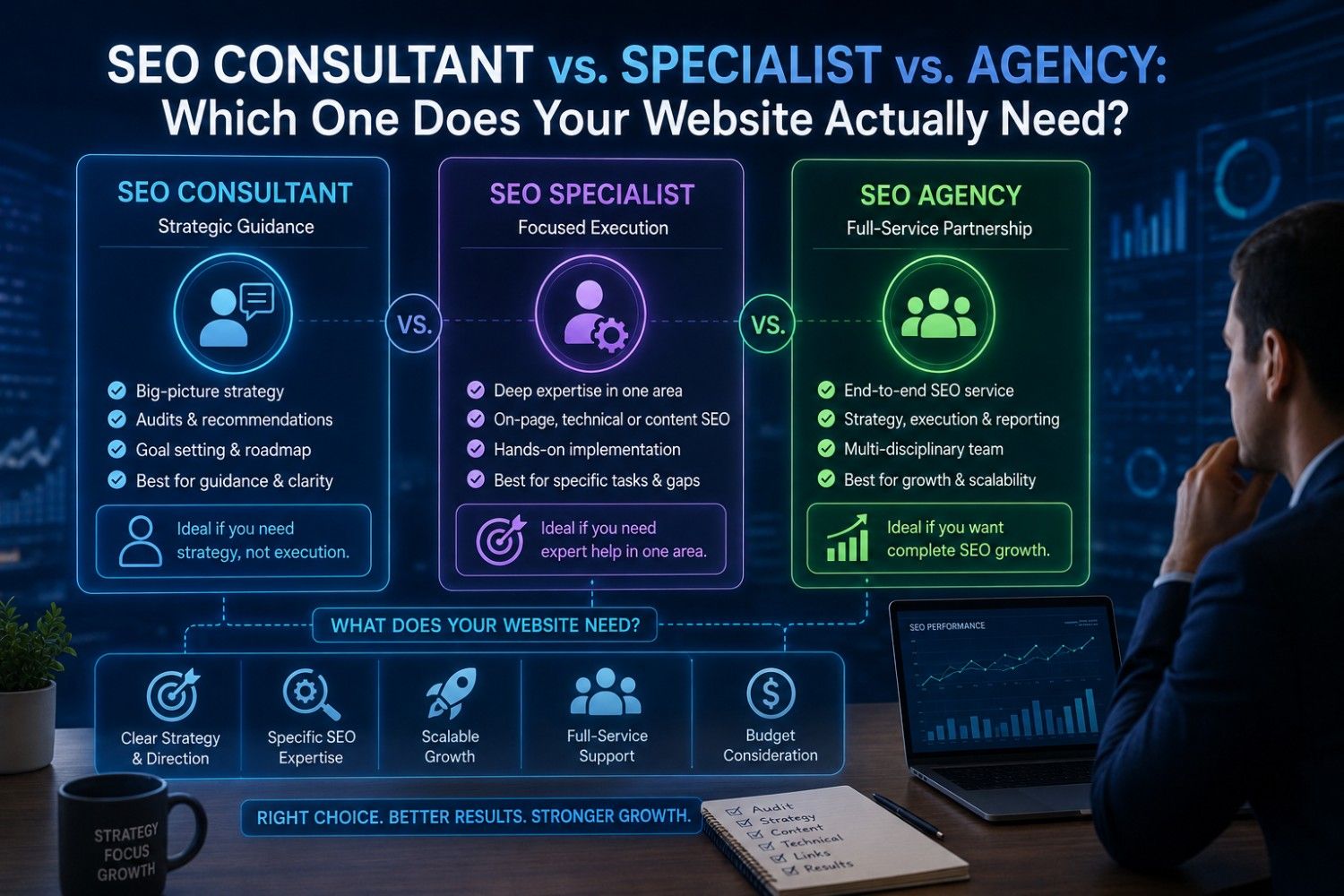
As a business owner, navigating this shift is challenging. To capture organic demand, you need the right expertise. However, when you look for a partner, you are faced with three distinct models: the SEO Consultant, the SEO Specialist, and the SEO Agency.
Choosing the wrong model can lead to wasted budgets, operational friction, or even severe technical penalties that can damage your digital presence.
This comprehensive guide breaks down the core differences between these three search marketing roles, exposes standard contract traps, explains how generative search affects your traffic, and helps you choose the perfect fit for your website’s growth.
To evaluate transparent options that match your business goals, exploring our specialized SEO services is an excellent first step in understanding what a legitimate engagement looks like.
Key Takeaways
- The shift toward generative search engines like Google’s AI Overviews, ChatGPT, and Perplexity requires businesses to coordinate traditional SEO with Answer Engine Optimization (AEO) and Generative Engine Optimization (GEO)
- Choosing between an SEO Consultant, Specialist, or Agency depends on your internal resources; consultants provide strategic blueprints, specialists execute day-to-day technical tasks, and agencies offer a full outsourced team
- Absolute ranking guarantees are an industry trap because search algorithms update constantly and results are highly personalized, meaning unethical providers often rely on zero-volume keywords or risky black-hat shortcuts
- Retaining full corporate ownership of your Google Analytics, Tag Manager, and Search Console accounts is critical to prevent data from being held hostage by a provider.
- While AI-generated search results are compressing traditional organic click-through rates, the remaining traffic is highly qualified, with AI-referred visitors converting at a significantly higher rate of 14.2% compared to 2.8% for traditional search.
The Taxonomy of Search Talent: Who is Who?
Understanding the differences between search providers requires a look at their daily work, strategic scope, and how they implement changes.
The SEO Consultant: The Strategic Diagnostic Expert
An SEO Consultant serves as a senior-level advisor and technical analyst. Their primary focus is on high-level diagnosis, competitive strategy, penalty recovery, and long-term search planning.
- How They Work: Consultants typically do not write copy, build links daily, or log into your website’s backend to make code changes. Instead, they perform deep audits and deliver highly detailed blueprints and technical specifications.
- The Implementation: Your internal software developers and content writers must execute the consultant’s plans.
- The Strategic Focus: Consultants connect search visibility directly to business outcomes, revenue growth, and long-term brand equity. They are typically hired to solve complex problems, such as a site migration, a sudden traffic drop, or aligning a global corporate structure.
The SEO Specialist: The Dedicated Tactical Executor
An SEO Specialist is a hands-on tactical execution expert who directly implements on-page, off-page, and technical updates.
- How They Work: Unlike consultants, specialists work directly inside your content management system (CMS). They write and edit metadata, optimize site speed, resolve crawl errors, implement schema markup, and adjust content headers.
- The Implementation: They do the work themselves or work as a direct, day-to-day extension of your existing marketing team.
- The Strategic Focus: Specialists focus on maintaining excellent search hygiene and winning keyword-level battles. While highly skilled at execution, they may lack the broader business experience required to manage multi-channel budgets or align search strategies with high-level corporate goals.
The SEO Agency: The Turnkey Outsourced Department
An SEO Agency is an integrated service provider that supplies a multi-disciplinary team to manage and scale your search campaigns.
- How They Work: An agency provides a complete, outsourced solution. Their teams typically include technical search engineers, copywriters, digital public relations experts, and dedicated account managers.
- The Implementation: The agency handles everything—from initial strategy and technical adjustments to monthly content production and link acquisition.
- The Strategic Focus: Agencies are built to scale content and build authority across highly competitive markets.
- The Agency Risk: The agency model is prone to client churn—which averages 38% annually across the industry—often peak-focused in the first 90 days. To combat this, some agencies utilize aggressive sales pitches and lock clients into rigid contracts while passing the day-to-day work to junior account managers.
Responsive Head-to-Head Comparison
To help you compare these options easily on any screen, we have mapped out how each model operates across key business factors.
Primary Scope of Work
- SEO Consultant: Strategic blueprints, diagnostic site audits, competitive gap mapping, and penalty recovery planning.
- SEO Specialist: Direct execution of technical tasks, keyword optimization, page layout tweaks, and ongoing search hygiene.
- SEO Agency: Turnkey search management, high-volume content production, link earning, and cross-channel strategy.
Primary Deliverables
- SEO Consultant: Highly detailed audit documents, content strategy plans, tracking specifications, and staff training sessions.
- SEO Specialist: Active website updates, meta tag adjustments, technical issue fixes, and baseline keyword reports.
- SEO Agency: Monthly content portfolios, acquired digital PR links, technical updates, and multi-channel reports.
Implementation Process
- SEO Consultant: Completely reliant on your internal developers and writing teams to execute the delivered strategies.
- SEO Specialist: Handled directly by the specialist working inside your content management system.
- SEO Agency: Executed end-to-end by the agency’s internal design, writing, and development teams.
Internal Resource Demands on Your Team
- SEO Consultant: High. You must have capable, in-house web developers and writers ready to implement their guidelines.
- SEO Specialist: Moderate. Requires direct access to your systems and basic strategic alignment from your management.
- SEO Agency: Low. Operates as an independent, outsourced search marketing department with minimal daily demands on your team.
Common Operational Risks
- SEO Consultant: Strategies can stall or remain unexecuted if your internal development queue is backlogged.
- SEO Specialist: Tactical focus can lead to isolated updates that fail to address broader, long-term business goals.
- SEO Agency: Risk of senior-to-junior handoffs, templated “cookie-cutter” strategies, and communication gaps.
Contract and Algorithm Warning Signs to Avoid
Before signing an agreement with any provider, business owners must learn to recognize common sales tactics, contract traps, and high-risk strategies. Many businesses review standardized SEO pricing packages to benchmark costs, but you must look deeper into the contract terms to protect your brand.
The Trap of Ranking Guarantees
- Why Guarantees Fail: Google’s search algorithms update hundreds of times a year. Because search results are highly personalized based on user location, browser history, and device type, absolute ranking guarantees are impossible. Google’s official documentation explicitly warns against any provider making these claims.
- Obscure Keyword Tricks: Unethical providers often satisfy guarantees by ranking your site for zero-volume keywords (e.g., highly specific geographic search terms that no one actually uses). While they can claim success, these rankings bring zero traffic or business value.
- The Danger of Black-Hat Shortcuts: Some providers use risky, black-hat shortcuts—like purchasing links from spam networks, keyword stuffing, and private blog networks (PBNs)—to force temporary ranking spikes. When search engines detect these practices, they apply algorithmic or manual penalties, causing immediate traffic drops of 50% to 95%. Recovering from a penalty is a slow process; only 30% of penalized websites recover their previous traffic within 12 months.
Data and Admin Control Traps
- Account Ownership Hostage: A major warning sign is when a provider insists on setting up your Google Analytics (GA4), Google Tag Manager, or Google Search Console accounts under their agency credentials rather than your corporate ownership. If you decide to leave, they may hold your historical performance data hostage or demand heavy exit fees.
- Proprietary Tracking Systems: Providers may require you to use custom, proprietary dashboards while blocking your access to native platforms. This makes it difficult to verify their reporting or transition your data smoothly if you cancel.
- Content Intellectual Property Clauses: Review your contract’s intellectual property (IP) clauses carefully. Some standard agreements state that any content written for your site remains the agency’s property until the contract is paid in full or indefinitely. If a dispute arises, the agency can legally remove all copy and code optimization from your site.
Strategy and Transparency Red Flags
- The “Secret Sauce” Excuse: If a provider refuses to explain their optimization methods or where they acquire backlinks, claiming their process is “proprietary,” they are likely hiding low-quality, automated tactics that violate search guidelines.
- Lack of a Domain Audit: A credible partner will never offer a firm proposal or pricing structure without first conducting a technical audit of your domain. If they pitch a strategy before understanding your site’s current health, they are selling a generic template.
- No Focus on AI Crawlers: In today’s search market, any proposal that ignores AI crawlers (like GPTBot, ClaudeBot, or PerplexityBot) is using an outdated playbook. Managing how AI search bots crawl and index your site is critical to maintaining visibility on AI-driven platforms.
The 2026 Reality: Coordinating SEO, AEO, and GEO
The rise of generative search has changed how organic visibility translates into traffic and conversions. Today, successful search campaigns require a coordinated effort across three distinct disciplines.
Defining the Search Layers
- SEO (Search Engine Optimization): Builds the technical and structural foundation of your site—focusing on crawlability, fast load speeds, clean internal linking, and search indexing.
- AEO (Answer Engine Optimization): Structures your content to be easily extracted by conversational algorithms and displayed as direct answers (such as featured snippets or voice answers).
- GEO (Generative Engine Optimization): Focuses on building your brand’s authority and entity consistency so AI systems like ChatGPT, Perplexity, and Google AI Overviews cite your brand as a trusted source.
Understanding the Drop in Clicks
- Click-Through Rate Compression: When Google displays an AI Overview, it occupies up to 80% of the visible space above the fold on desktop screens. This pushes traditional listings down, reducing the average click-through rate of the top organic spot from 28.5% to 11.2%.
- The Zero-Click Trend: Searches that conclude without a single click to an external website have reached nearly 60% of all queries. When an AI Overview is present, that zero-click rate rises to roughly 83%.
- Why Clicks Fall but Conversions Rise: While top-of-funnel informational traffic is declining, the remaining traffic is highly valuable. Generative answers satisfy casual searchers directly on the search page, filtering out low-intent users. Users who click on reference links within an AI response are deep in the consideration phase. Studies show that AI-referred visitors convert at an average rate of 14.2%, compared to just 2.8% for traditional organic search—representing a massive conversion advantage.
To learn more about how these generative formats are changing search behavior, check out our guide on AI-generated search summaries or explore Google AI Mode default traffic trends to see how AI-assisted discovery impacts traditional analytics tracking.
Decision Matrix: Which One Does Your Website Need?
Your choice of a search marketing partner should depend on your internal technical resources, content development capacity, and budget.
You Need an SEO Consultant If:
- You have an in-house development and content writing team that can execute changes but lacks strategic direction.
- Your site has suffered a sudden, major traffic drop or search penalty that requires deep technical analysis.
- You are planning a major website migration, redesign, or domain consolidation.
- You want to train your internal team to manage search optimization in-house.
You Need an SEO Specialist If:
- You have a clear marketing strategy but need a dedicated resource to handle daily, technical implementation.
- Your current marketing staff is stretched thin and cannot focus on details like schema updates or keyword mapping.
- You need hands-on help optimizing pages, updating existing content, and fixing technical crawl errors.
- You require a dedicated resource to work directly inside your CMS on a daily basis.
You Need an SEO Agency If:
- You have no internal web developers, writers, or search strategists.
- You want a single, outsourced partner to manage your entire organic search lifecycle.
- You need to scale original content creation, earn authoritative links, and handle deep technical work simultaneously.
- You want to build clean brand authority through targeted digital PR services to secure genuine, high-quality citations.
Actionable Scorecard for Choosing Wisely
When interviewing potential search partners, use this scorecard to evaluate their methods, transparency, and operational standards.
Initial Technical Analysis
- The Expectation: The candidate conducts a detailed technical audit of your domain before presenting a commercial proposal.
- Green Flag: Delivers a customized analysis highlighting site speed, indexation issues, and competitive keyword gaps.
- Red Flag: Offers standard pricing tiers and a generic proposal template without analyzing your specific site.
Performance Promises
- The Expectation: The candidate sets realistic traffic projections and organic growth expectations.
- Green Flag: Focuses on organic traffic trends, lead generation metrics, and business conversions.
- Red Flag: Guarantees specific page-one rankings or fast position wins.
Link-Building Practices
- The Expectation: The candidate outlines a clear, manual outreach strategy to build domain authority.
- Green Flag: Earns relevant citations through manual outreach and original research.
- Red Flag: Sells “bundled link packages” or relies on private, undisclosed link networks.
Core Technology Ownership
- The Expectation: All analytics and search accounts are owned directly by your brand.
- Green Flag: Sets up tracking properties under your corporate accounts, utilizing delegated access for the agency.
- Red Flag: Installs tracking tools nested under agency-owned master accounts.
Contract Flexibility and IP Rights
- The Expectation: The agreement outlines transparent exit options and immediate asset ownership.
- Green Flag: Offers flexible month-to-month terms or clear performance-based termination options, with immediate IP transfer of all assets.
- Red Flag: Requires long-term contracts with no exit options, and retains content IP ownership until full contract value is paid.
Actionable Recommendations for Growth
To build a resilient search presence that can withstand algorithm updates and drive consistent business results, your search strategy must adapt to the modern landscape.
First, shift your optimization strategy to focus on topic depth and structured content rather than simple keyword lists. This involves building an SEO strategy without chasing keywords to target broader topical authority and answer-focused content clusters.
Second, format your content to satisfy both traditional search algorithms and conversational AI search features. This is achieved by utilizing Answer Engine Optimization (AEO) to structure your content into clear, direct answers that generative engines can easily parse and cite.
Third, if you run a complex website, your partner must have the specialized knowledge required to handle your specific system. For online stores, this means hiring a team experienced in ecommerce SEO to address complex technical challenges like faceted navigation and product schema.
Finally, evaluate your potential partner’s core philosophies and track record. To understand how we build transparent partnerships, explore our about us page or learn about our joint growth initiatives on our partnerships page.
If you are ready to initiate a diagnostic technical audit and build an organic growth plan that drives real business results, we invite you to reach out directly via our contact us page.
To find more checklists, expert guides, and diagnostic frameworks, visit the primary SWS Marketing Agency hub or explore our curated blog resources library. For specific local business optimizations, check out our tailored Chicago SEO services or Austin SEO services to analyze regional growth programs. To review general digital marketing services, visit our services page, explore the SEO category for optimization deep-dives, or browse the AI search category to stay ahead of generative search updates.
FAQs
What is the difference between an SEO Consultant, Specialist, and Agency?
An SEO Consultant acts as a senior strategic advisor providing audits and blueprints. An SEO Specialist is a tactical executor who works directly inside your CMS to make updates. An SEO Agency provides an entire outsourced team to handle strategy, content production, and link earning at scale.
Why are ranking guarantees a red flag in search marketing contracts?
Search algorithms update hundreds of times a year and results are highly personalized, making absolute guarantees impossible. Providers who promise rankings often use black-hat shortcuts that risk severe site penalties, or they target obscure, zero-volume keywords that bring no business value
How do AI Overviews and generative search affect website traffic?
Generative search layouts occupy significant screen space, which pushes traditional listings down and contributes to rising zero-click search rates. However, while top-of-funnel informational traffic may decrease, the visitors who do click through are deeply qualified and show much higher conversion rates.
What are SEO, AEO, and GEO, and why do they matter together?
SEO focuses on the technical structure and indexation of your site>. AEO (Answer Engine Optimization) formats content to be easily extracted as direct answers, while GEO (Generative Engine Optimization) optimizes your brand’s overall authority so AI models cite your business as a trusted source.
What data ownership traps should a business look out for?
Always ensure that platforms like Google Analytics (GA4) and Google Search Console are set up under your own corporate credentials rather than the provider’s agency account. Otherwise, an agency can hold your historical performance data hostage or demand heavy exit fees if you separate.

SWS Marketing is a white label digital marketing company which provide services to both agencies, and clients around the world. Our small team of SEO, PPC and social media experts deliver high-impact digital marketing solutions that help businesses grow their online presence. Agencies and Clients benefit from increased brand awareness, traffic, visibility and leads, created by our data-driven approach to search engine optimization(SEO), PPC, social media marketing, content marketing, digital PR, guest posting and more!